Pump On or Pump Off? What the Timing of Your Pool’s Water Loss Tells Us
Most people describe a leak the same way: “the pool is losing water.” That sentence tells us almost nothing on its own. The useful detail is when the water disappears — because a pool that drops faster while the pump runs has a different problem, in a different place, than one that drops quietly overnight. It is the single most valuable thing a homeowner can tell us before we arrive, and it costs nothing to find out.
Schedule Your Leak Detection Today
The leaks won’t fix themselves. Prevent high bills and long-term damage.
Plan long-term solutions with an in-depth assessment.
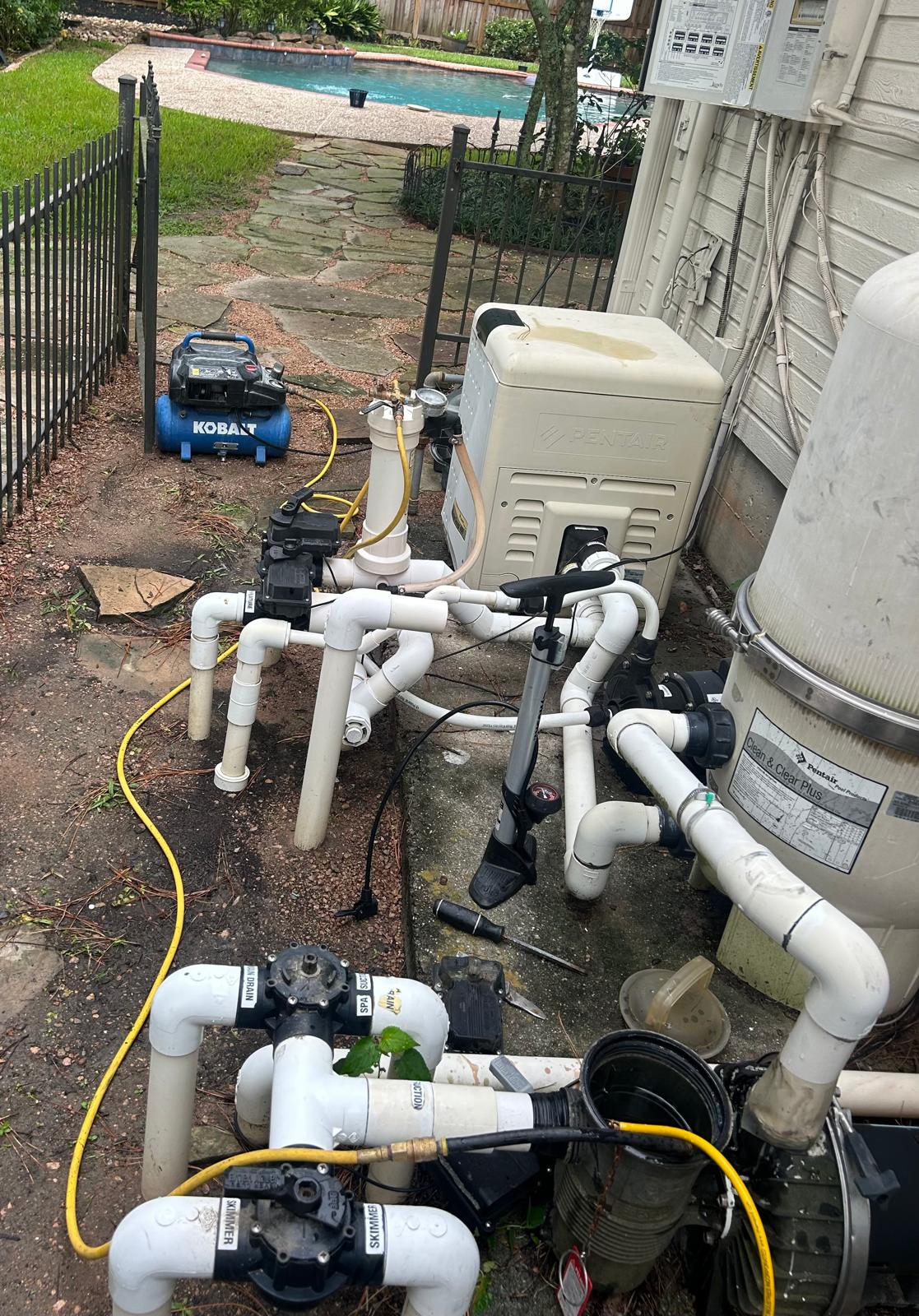
Pool plumbing splits into two halves, and the shell is a third category on its own. Each leaks with its own signature. Loss speeds up when the pump runs — the pressure side. These are the return lines carrying filtered water back to the pool. When the pump is on, they are pressurized, and any crack becomes a small fire hose pushing water into the soil. Shut the pump off and the pressure drops, so the leak slows dramatically. This is the pattern that also washes out soil the fastest, because water is being forced rather than seeping. Loss is steady day and night — the shell. Cracks in the plaster, gunite, tile bed, or around a light niche do not care whether the pump is running. Water leaves at whatever rate gravity and the water level allow. If your loss is roughly the same with the system off, we start looking at the structure rather than the pipes. Loss is worse with the pump off, or you see air in the returns — the suction side. Skimmer and main drain lines are under vacuum while the pump runs, so they tend to pull air in rather than push water out. The tell is air bubbling from the returns, or the pump losing prime. When the system shuts down, those same lines can drain backward and lose water. Each line isolated and pressure tested on its own at the equipment pad.
How to run the test yourself
This costs you two days and a pencil mark, and it makes your appointment far more efficient.
Mark the water level exactly — a piece of tape on the tile is better than guessing
Turn the pump off completely for 12 hours, then measure the drop
Refill to the mark, run the pump on its normal schedule for 12 hours, measure again
Turn off the autofill for the whole test, or it will quietly erase your data
Compare the two numbers. More loss with the pump on means pressure side. Roughly equal means shell. More loss with it off, or air in the returns, means suction side. One caution: in Bellaire’s summer heat, evaporation alone can take a quarter inch a day, and it happens during both halves of the test. What matters is the difference between the two numbers, not the raw figures.
What we do at the equipment pad
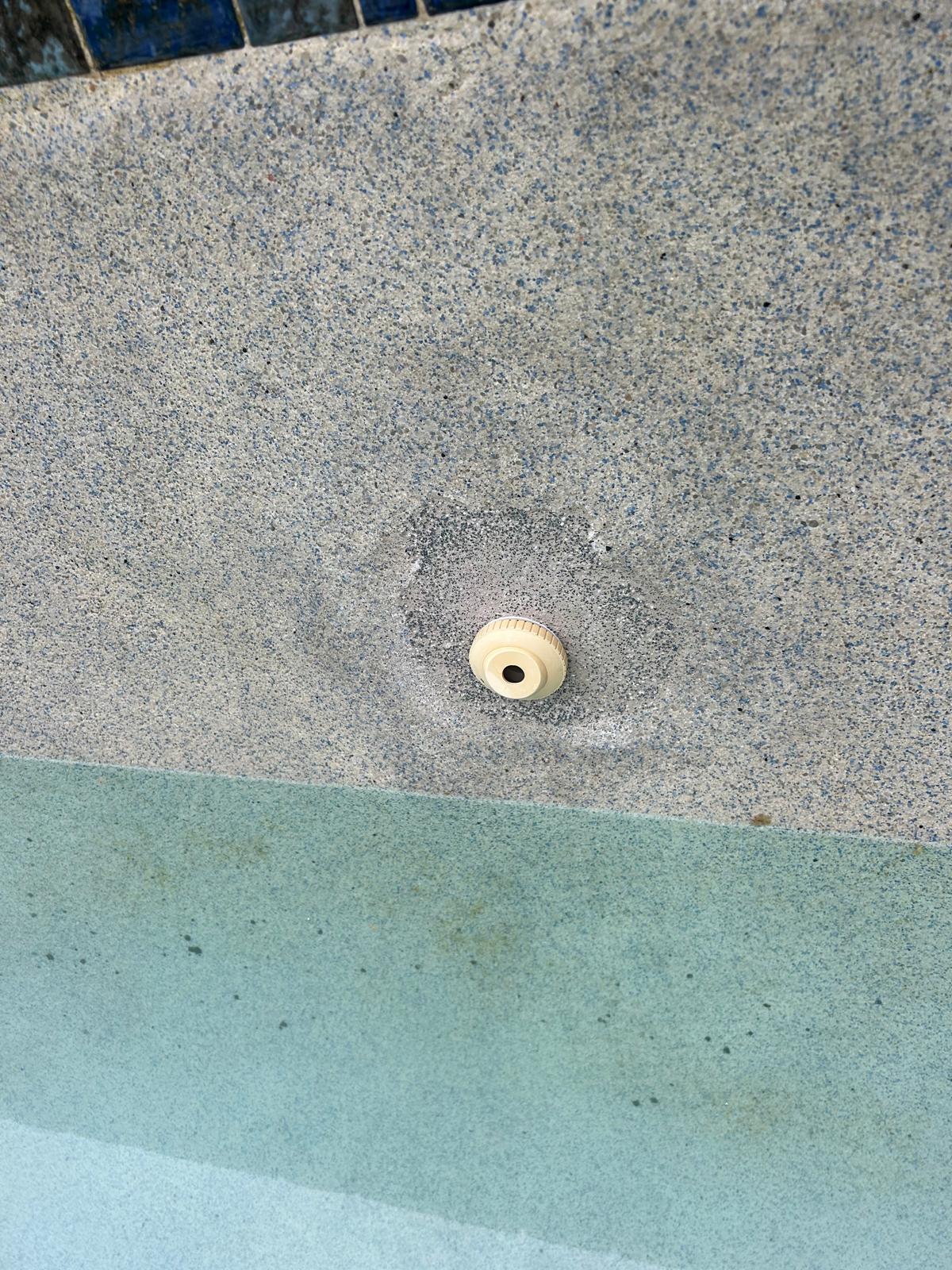
The photo above is a real Bellaire job. That air compressor and gauge are not decoration — they are how we turn your observation into an exact location. We close the valves so each line stands alone, then pressurize them one at a time and watch the gauge. A line that holds steady is fine. A line that bleeds down is the one with the hole. From there we listen electronically along the pipe run and mark the spot, usually within a foot or so. That is the difference between a targeted repair and an exploratory dig. In the second photo you can see how a finished pressure side repair looks once the fitting is reset and the plaster patched — a patch the size of a dinner plate instead of a trench across the yard. A finished pressure side repair: fitting reset, plaster patched, nothing else disturbed.
Why older Bellaire pools show this more often
Bellaire has a lot of pools built in the 1960s through the 1980s, many of them replumbed once already. Old thin-wall PVC, glued joints that have been pressure cycling for forty years, and repairs layered on top of repairs all concentrate failures on the pressure side. The returns are simply the pipes that get worked hardest. Add the clay soil common through the inner loop, which swells and shrinks with the seasons and pulls on pipes anchored to a shell that does not move, and the pattern makes sense.
When to stop testing and call
Run the pump-on/pump-off test once. If the answer is obvious, you have already narrowed our search by two thirds. If you are losing more than about half an inch a day beyond what evaporation explains, or you can see wet ground, sinking deck, or air in the returns, it is worth having it looked at rather than watching it another month. We do pressure testing and return line repair across Bellaire and the inner loop. Call (346) 850-9775 or schedule online, and tell us which way your pool behaved — it genuinely speeds things up.
Common Questions
Does a pool leak get worse when the pump is running?
It does if the leak is on the pressure side. The pump pushes water out through the crack, so the loss speeds up while the system runs and slows when it shuts off. A leak in the shell behaves the opposite way and stays fairly steady.
Can I find out which side is leaking myself?
You can get close. Mark the water level, leave the pump off for 12 hours and measure, then run it normally for 12 hours and measure again. Losing more with the pump on points to the pressure side. Losing about the same either way points to the shell.
Why test each pool line separately?
Because the skimmer, main drain, return and spa lines all run to different parts of the yard. Testing them one at a time tells us which run is bad, so we dig one small hole instead of opening the whole deck.
Hi! I'm Orbit's assistant. Ask me anything about pool leak detection and repair — how our service works, pricing, scheduling, or your specific pool problem.
AI answers may be imperfect. For urgent issues, please contact us directly.