
What a Houston Pool Dye Test Caught After the Pressure Run
Some leaks show up on a gauge. Others only show up in water you can watch. On this concrete pool, a Houston pool dye test and a full pressure run worked side by side, and each method caught a different leak.
Here is how the two methods split the work, and why skipping either one would have left a leak behind.
Two methods, two jobs
Pressure testing looks inside the pipes. First, we plug a line at both ends and bring it up to 12 psi. Then we watch the gauge. If the needle holds, the pipe is tight. If it falls, water is escaping somewhere along that run.
Dye testing looks at the shell and the fittings instead. Our technician releases a small amount of colored dye next to a suspect spot in still water. When there is a leak, the dye drifts toward the opening and disappears into it. When there is none, it simply hangs in place.
Neither method replaces the other. In fact, this job shows exactly why we use both.
What the pressure run showed
We started with the plumbing. The skimmer line held 12 psi, and so did the main drain, the common line and the water feature lines. The equipment and the lights passed as well. Only one line failed: the pool returns. As soon as we pressurized that run, the gauge began to fall.
That result told us two things. A leak sat somewhere along the return plumbing, and the rest of the pipes were fine. Because the return line runs under the stone deck, the fix is an under-deck repair at the leak spot rather than a broad dig.
Where the Houston pool dye test came in
A clean pressure result on the skimmer line does not clear the skimmer itself. The pipe can be tight while water slips out around the skimmer body, right where it joins the concrete. So, next, our technician took the dye to the skimmer throat.
The dye did not hang in place. Instead, it pulled toward the throat, which confirmed a second leak at that spot. You can see the area in the photo below.
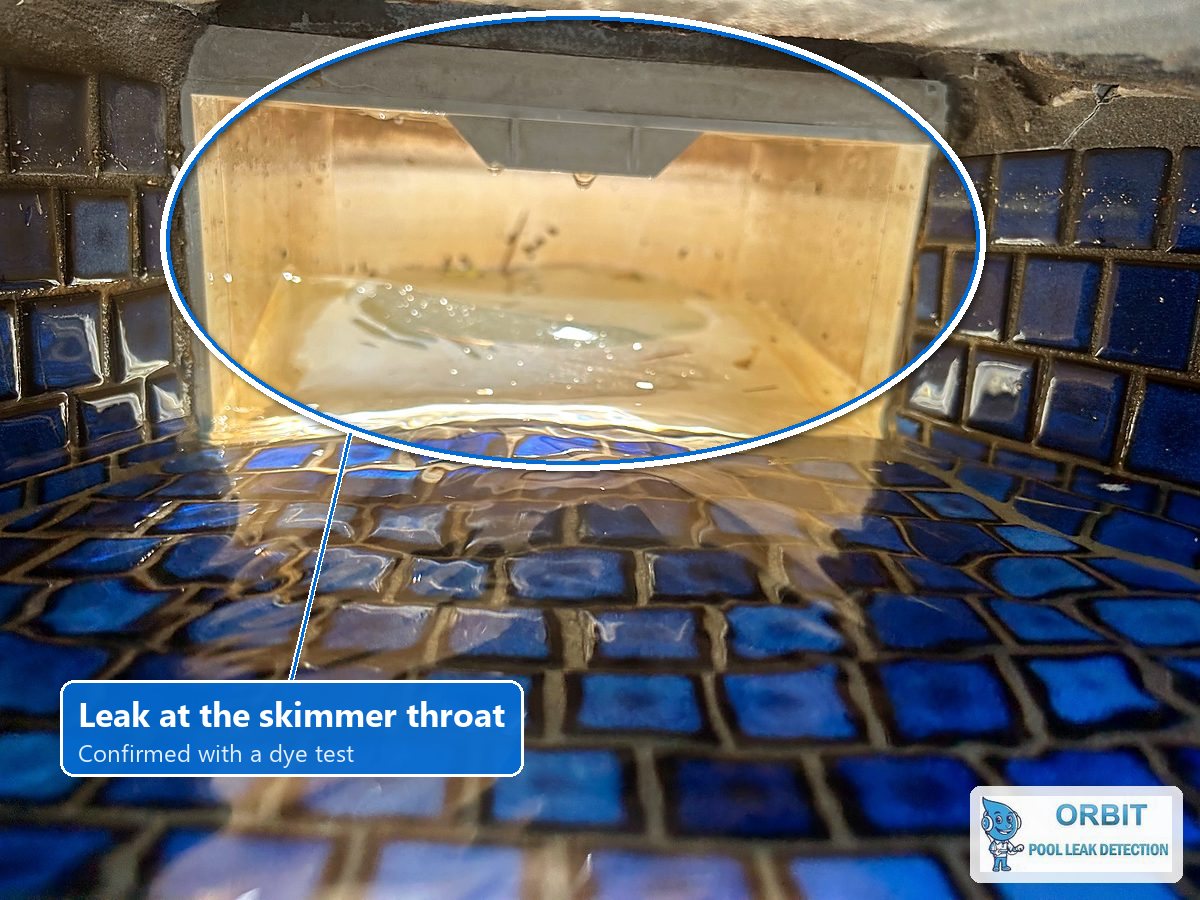
We also dye-checked the rest of the pool surface, and it came back clean. Then we ran hydrostatic checks on the drains and on the sheer descent. None of them showed a leak.
Why one method alone would miss a leak
Imagine stopping after the pressure run. The crew would fix the return line, but the skimmer would keep leaking, because its pipe passed. On the other hand, a dye-only visit might find the skimmer and miss the return line completely, since that leak sits inside a buried pipe.
Either way, the owner would still be topping off the pool after the repair. That is frustrating, and it is avoidable.
The repair plan
The report lists two repairs. The first is an under-deck repair on the return line at the marked location. The second is a skimmer injection, which seals the leak at the throat while the existing skimmer stays in place. We price each repair on its own after the leak detection, so the owner can review every item before deciding.
What to expect on test day
A full visit follows a set order. First come the pressure tests on every line. Next come the hydrostatic checks on drains and features. Finally, the technician dye-tests the skimmers, fittings and surfaces. Each result goes into a written report with photos, so you can see what passed and what did not.
If you live in the area, our Houston pool leak detection page explains how we work across the city. You can also read about skimmer leak repair and return line leak repair. Homeowners across Harris County have left their feedback on our Google page.
Why would a skimmer leak if its pipe passed the pressure test?
The pressure test only checks the pipe behind the skimmer. Water can still escape where the skimmer body meets the concrete, and a dye test is how we confirm that spot.
Does dye testing work on every part of the pool?
It works well on visible spots in still water, such as skimmers, fittings, lights and cracks. Buried pipes need pressure testing, because dye cannot reach them.
Losing water and not sure where it goes? Request your test date and we will run both methods on your whole pool.