
The Joint Fails Before the Pipe Does
In twenty years of opening ground around Houston pools, we have cut out very few lengths of pipe that failed in the middle. PVC is tough. Buried, out of sunlight, carrying water at low pressure, a straight run of schedule 40 will outlast most of the house.
What fails is the places where the pipe stops being a straight run: the glued joints, the fittings, and the transitions between one kind of pipe and another. If you understand why, you can usually predict where an old Pasadena pool is going to leak.
Flexible pipe glued into rigid fittings
A lot of pools built here from the 1980s onwards used flexible corrugated pipe for the awkward runs — around tight curves, up to spa jets, out to a cleaner line. It is quick to install and it bends where rigid pipe would need three fittings.
The trouble is at the ends, where the flex has to be glued into a rigid PVC fitting.
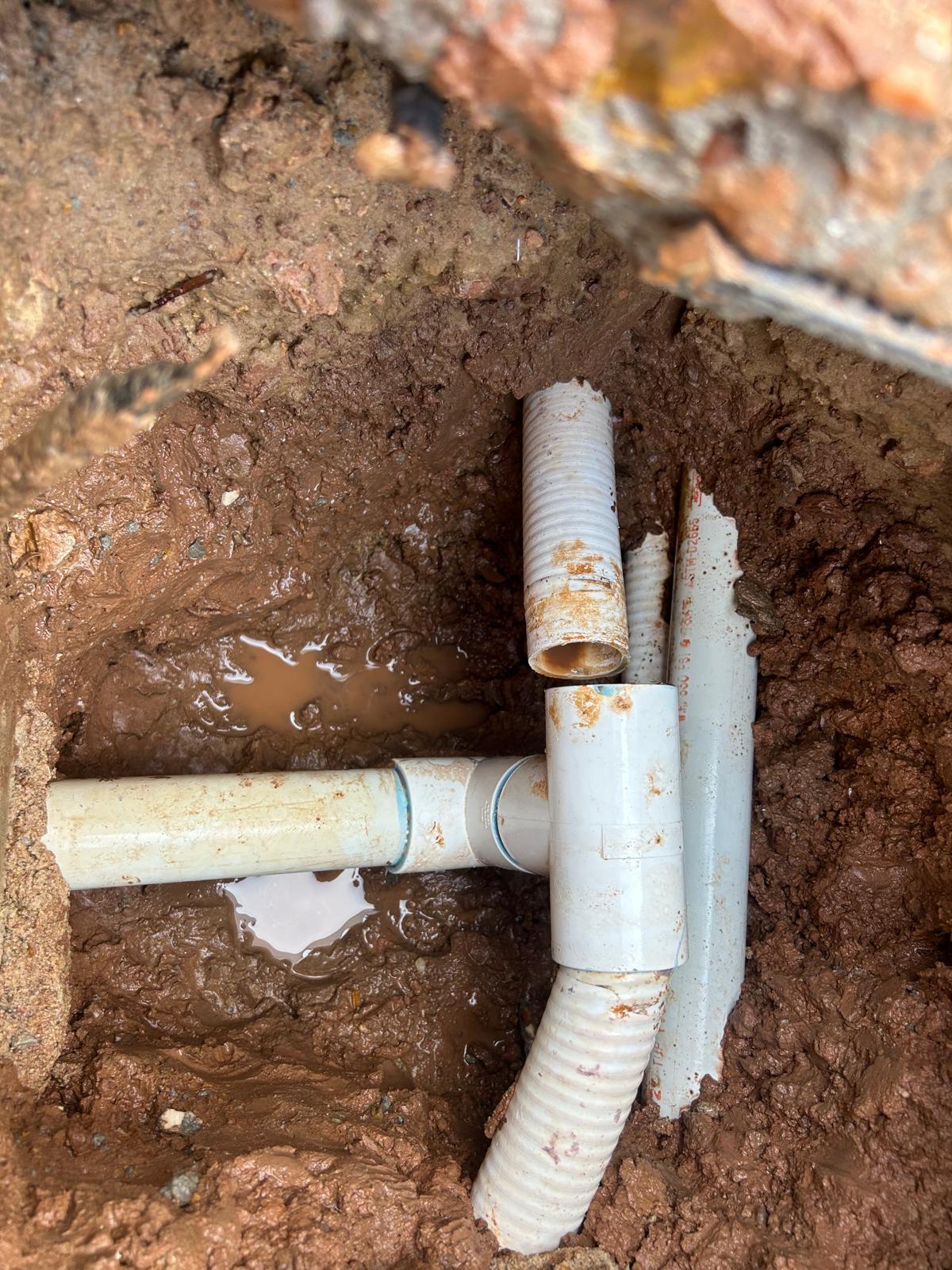
Two different materials, two different stiffnesses, one joint holding them together. The rigid fitting does not move. The flex pipe does — every time the ground swells and shrinks, every time the pump starts and the line pressurises. All of that movement concentrates at the glue line.
The staining you can see around that socket is the tell. Iron in the soil follows the water out of a weeping joint and leaves a rust coloured halo behind. When we open ground and find that pattern around a fitting, we have almost always found the leak.
Where the ground stops moving and the concrete starts
The second reliable failure point is anywhere a buried pipe passes under the edge of a slab.
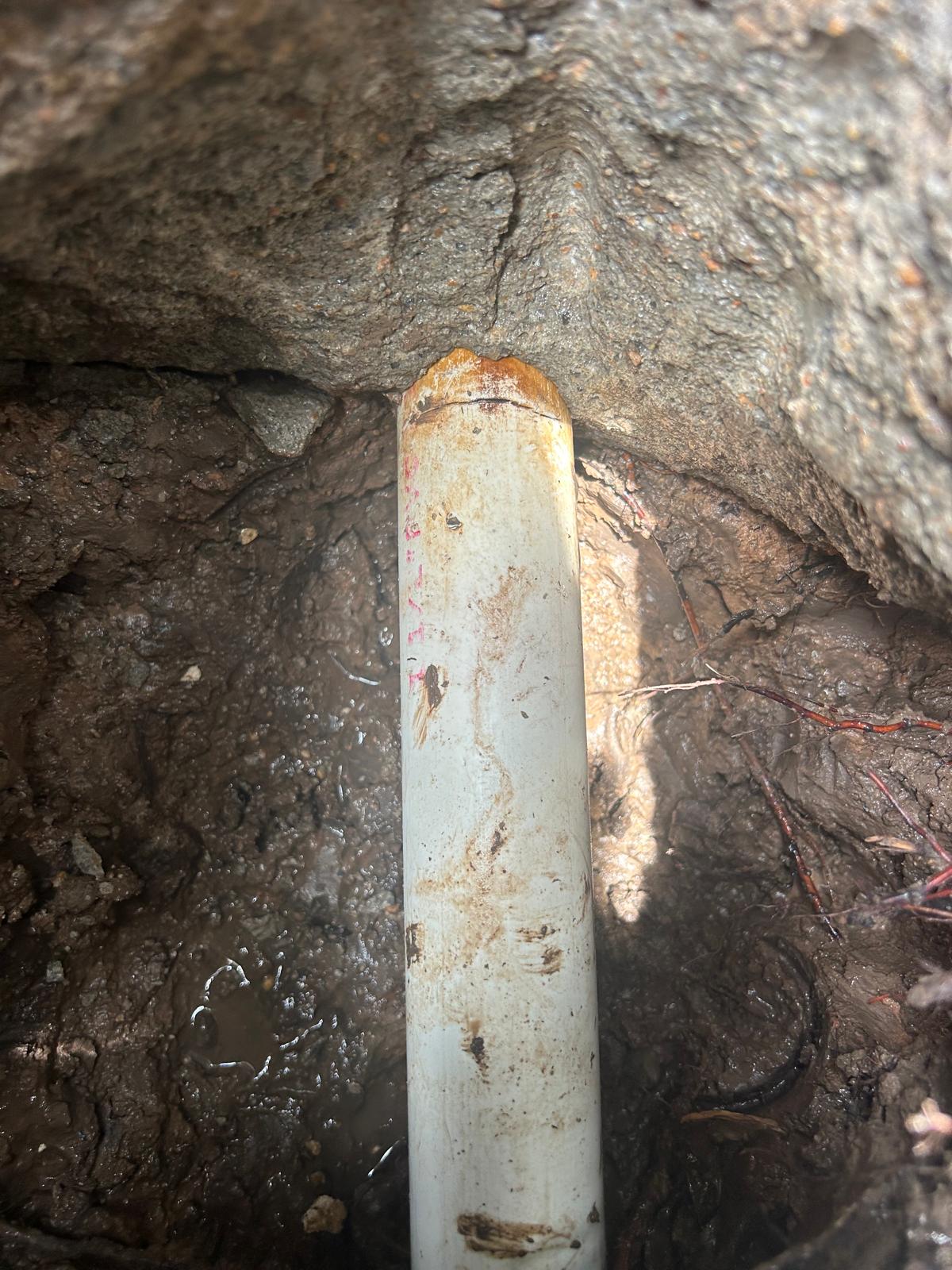
On one side of that line is soil that rises and falls with the seasons. On the other is a concrete deck that does not. The pipe has to cross the boundary, and the bending all happens in the few inches at the edge.
Pasadena’s soil makes this worse than most. Heavy clay through a dry summer shrinks and pulls away; the first serious rain swells it back. A pipe pinned under concrete at one end and sitting in that clay at the other gets worked back and forth every year until something gives, and it gives right at the line where the concrete starts.
Same story at the pool shell itself, where a line comes out of the gunite. The shell does not move. The soil does.
What this means for finding it
It means we do not search a pipe run evenly. We start at the places where the design says stress collects: fittings, transitions, the deck edge, the shell penetration, the equipment pad. Nine times out of ten it is at one of them, which is why a located leak usually needs one small opening rather than a trench.
Pressure testing tells us which line. Listening along the run tells us roughly where. Knowing where joints fail tells us where to look hardest when the first two narrow it to a few feet.
How the repair is made
The failed section comes out completely. We do not patch a cracked fitting or wrap a weeping joint, because both are temporary and both mean opening the same hole again.
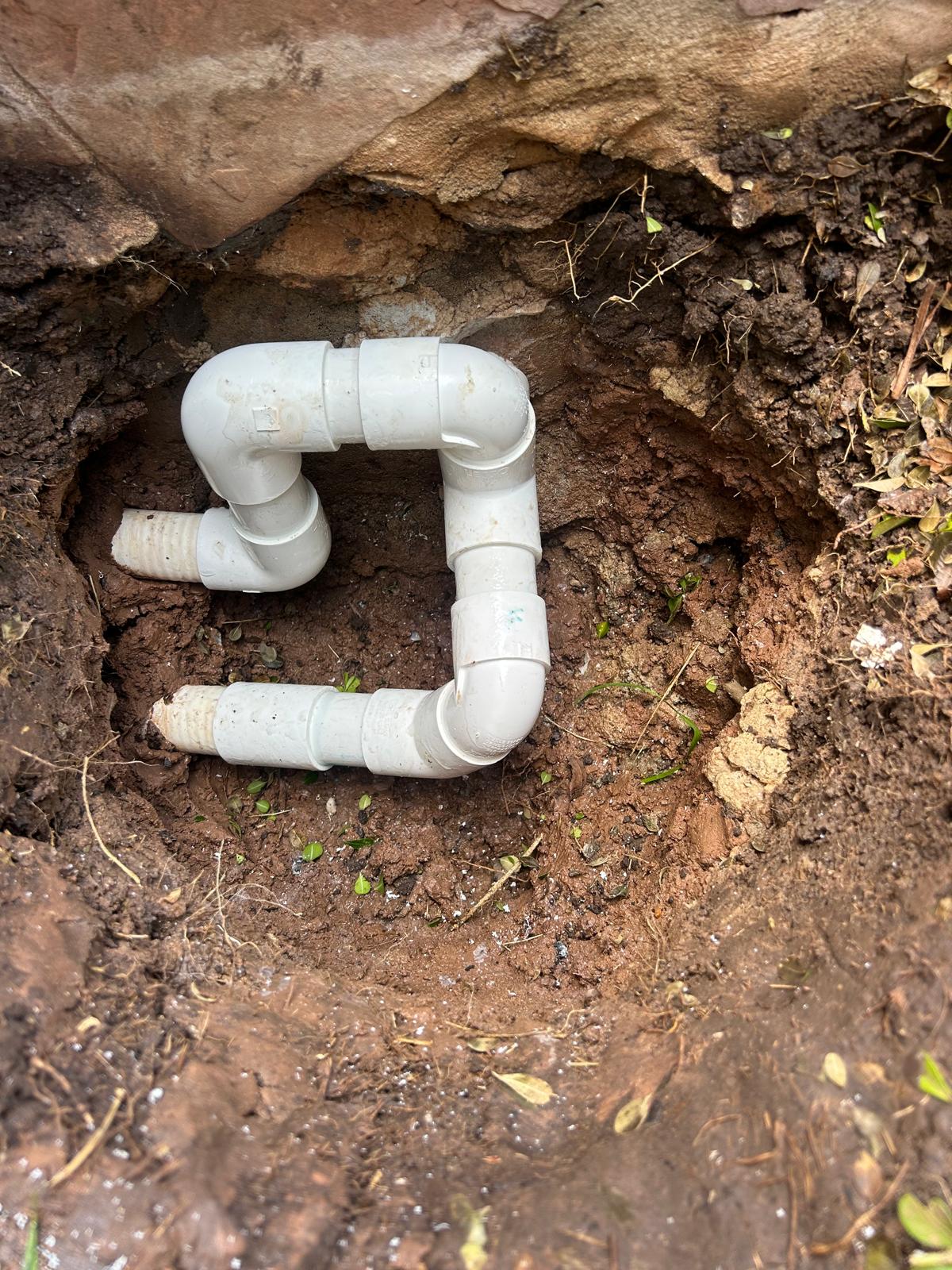
New rigid pipe goes back in, in schedule 40 rather than flex, and the geometry is built with fittings instead of by bending anything. The offset in that photo steps the new run around the old failure without putting any strain on the ends it connects to.
Then it is pressure tested before it is buried, and bedded in clean fill rather than dropped back into rubble. Sharp rock against PVC is a slow leak waiting to happen.
Can you predict your own pool?
Roughly, yes. If your pool is over twenty years old, has flexible pipe, and sits on the clay that most of this side of Houston sits on, the joints are the part with a service life. That is not a reason to replumb a pool that is working. It is a reason to take a small, steady water loss seriously rather than topping it up for another season.
We cover Pasadena, Deer Park and the east side for line repair and leak detection. Call (346) 850-9775.
Common Questions
Why do pool pipes leak at the joints rather than in the middle?
Because the joints are where movement concentrates. A straight buried pipe is barely stressed, but a glued socket joining two parts of different stiffness takes all the flexing when the ground moves or the line pressurises.
Is flexible pool pipe bad?
It is not defective, but it has a shorter service life than rigid PVC and it fails at its glued ends. When we replace a failed section we go back in with rigid schedule 40 and build the bends with fittings.
Why does clay soil cause pool leaks in Houston?
Because it changes volume with moisture. It shrinks away in a dry summer and swells with rain, so anything buried in it is pushed and pulled every year. Pool pipes are anchored at both ends — to the shell and to the equipment — so that movement has to go somewhere.