
Draining a Pool to Repair Cracks: When It Is Necessary and What It Involves
We avoid draining pools. Not because it is difficult, but because an empty pool is a pool at risk, and most leaks can be found and fixed without ever taking the water out.
But some cannot. When a gunite shell has cracked structurally, the repair has to be made dry, and the pool has to come down. This is what that job actually looks like, and why we take it seriously rather than treating it as a routine step.
Why an empty pool is a risk
A pool shell is designed to have water in it. The weight of that water is what holds it down against the ground it sits in.
Take the water out and the balance changes. If the water table is high — and around Montgomery and Lake Conroe, after a wet week, it often is — groundwater pressure under the shell can lift it. A floated pool is not a repair job any more; it is a replacement. That is why we check conditions and the forecast before draining anything, and why we do not drain a pool and leave it standing empty over a weekend if we can help it.
Plaster is the second reason. A surface that has spent years underwater does not enjoy being dried out in Texas sun. Old plaster can craze and check when it dries, and a pool that is drained for a week in July often needs more surface work afterwards than the crack repair itself.
What a structural crack looks like once the water is gone
Underwater, most cracks look like a hairline pencil mark. Drained, they show their real shape.
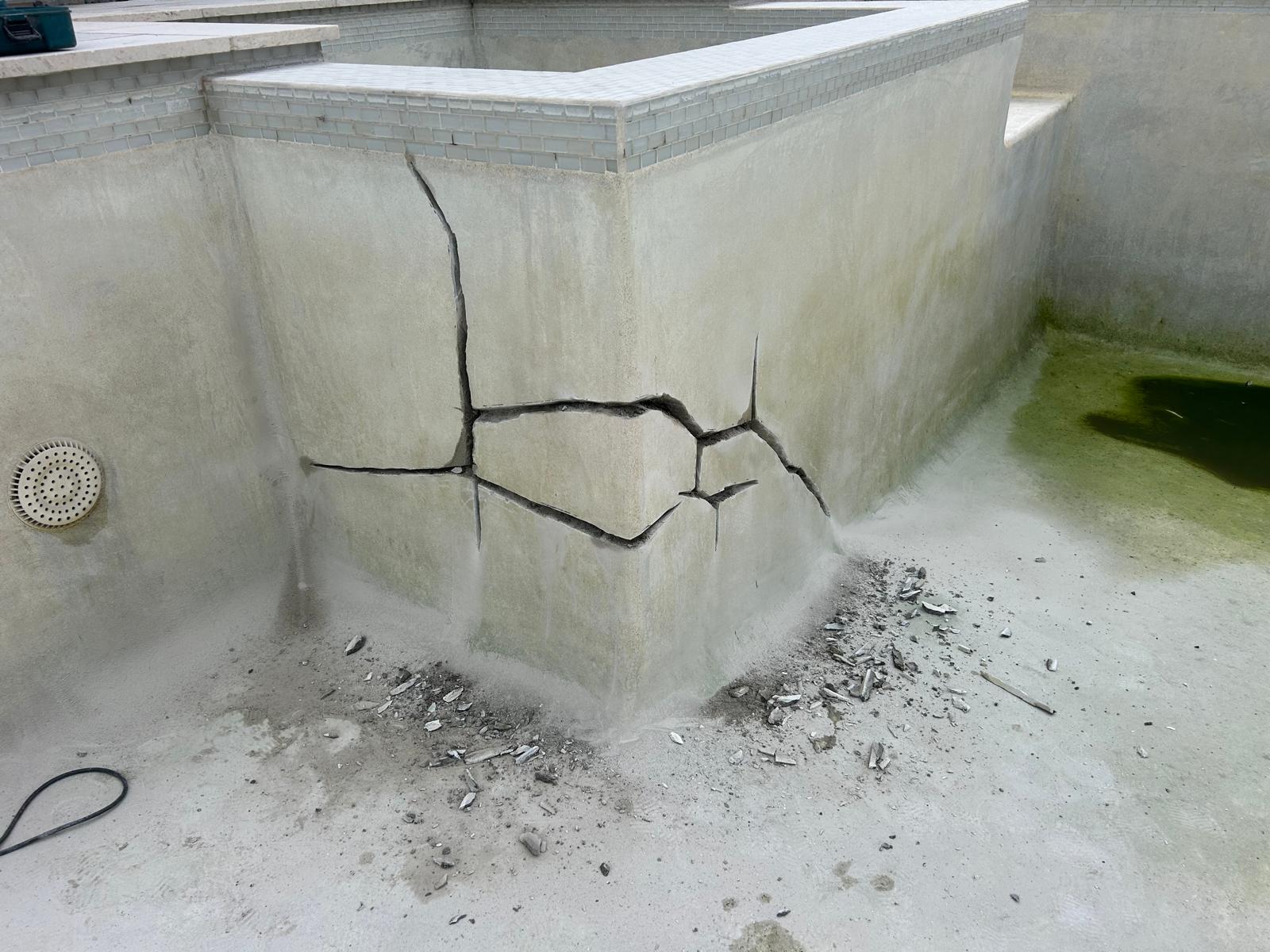
That is a raised wall on a drained pool with the cracks already chased out. The pattern is worth reading: a vertical run coming down from the tile line, then a long horizontal branch, then shorter legs splitting off it. That is a wall that has been pushed, not a surface that has simply shrunk.
Cosmetic crazing in plaster is a fine web of shallow lines that goes nowhere. Structural cracking has direction and continues through the material. Telling them apart is most of the diagnosis, and it is the difference between a surface repair and a job like this one.
Chasing the crack out
You cannot fill a hairline crack. There is nothing for the material to hold on to, and anything you smear over the top will fail within a season.
So the crack is opened up — chased into a clean groove with square shoulders, cut back until the edges are sound gunite rather than loose or delaminated material.
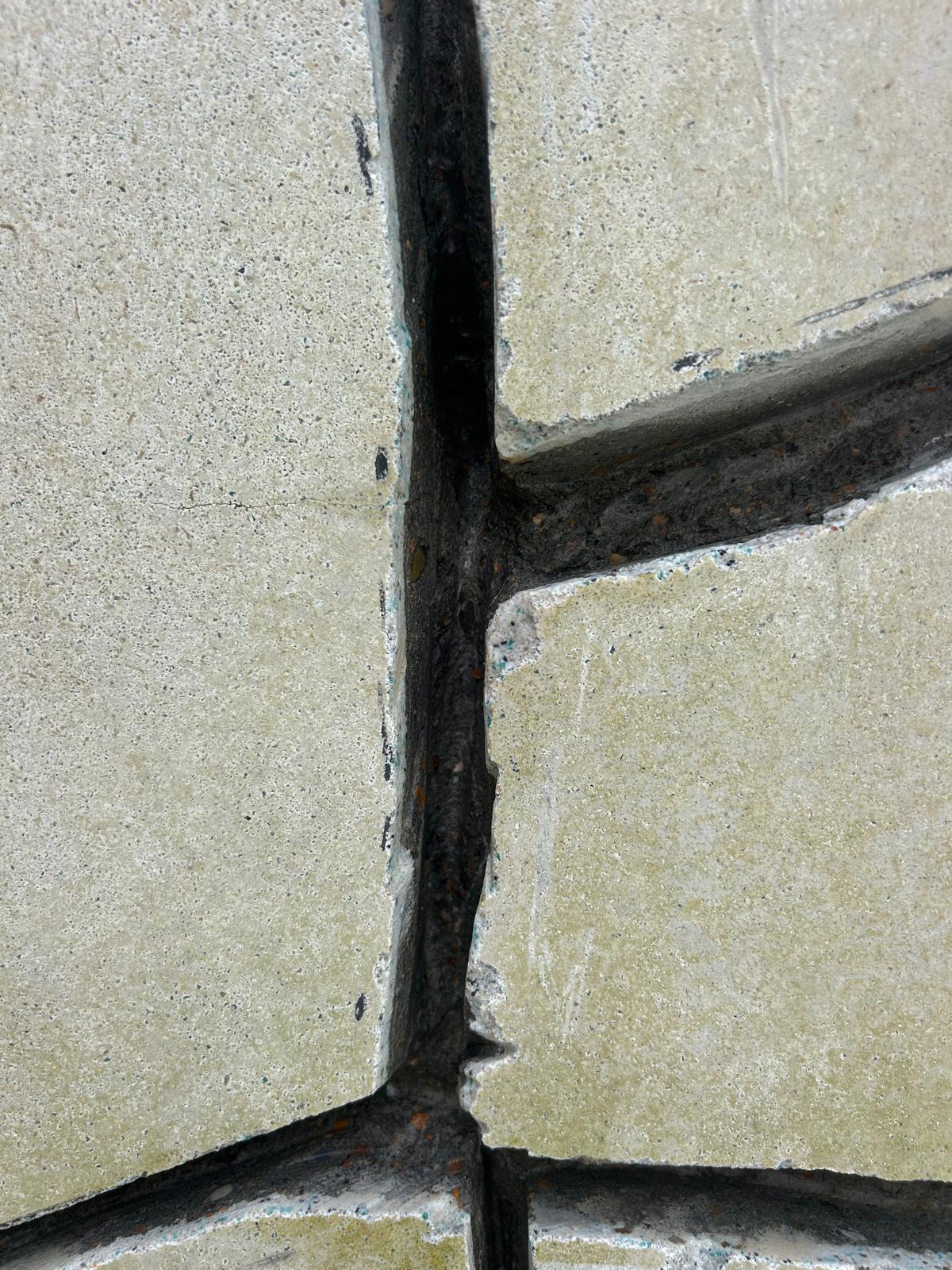
It looks worse at this stage than it did before we started, and customers say so. It is meant to. The groove is what gives the repair a mechanical key and a real bonding surface on both faces instead of a feathered edge over a void.
Where the crack runs through the shell rather than just the surface, the repair also needs to deal with the movement that caused it. Filling a moving crack with something rigid gets you the same crack back, usually within a year and usually half an inch to one side.
Filling and finishing
The groove is cleaned out, dampened, and filled in layers with a bonding material chosen to suit the joint rather than whatever is in the truck. It is worked in rather than laid on top, and finished flush.
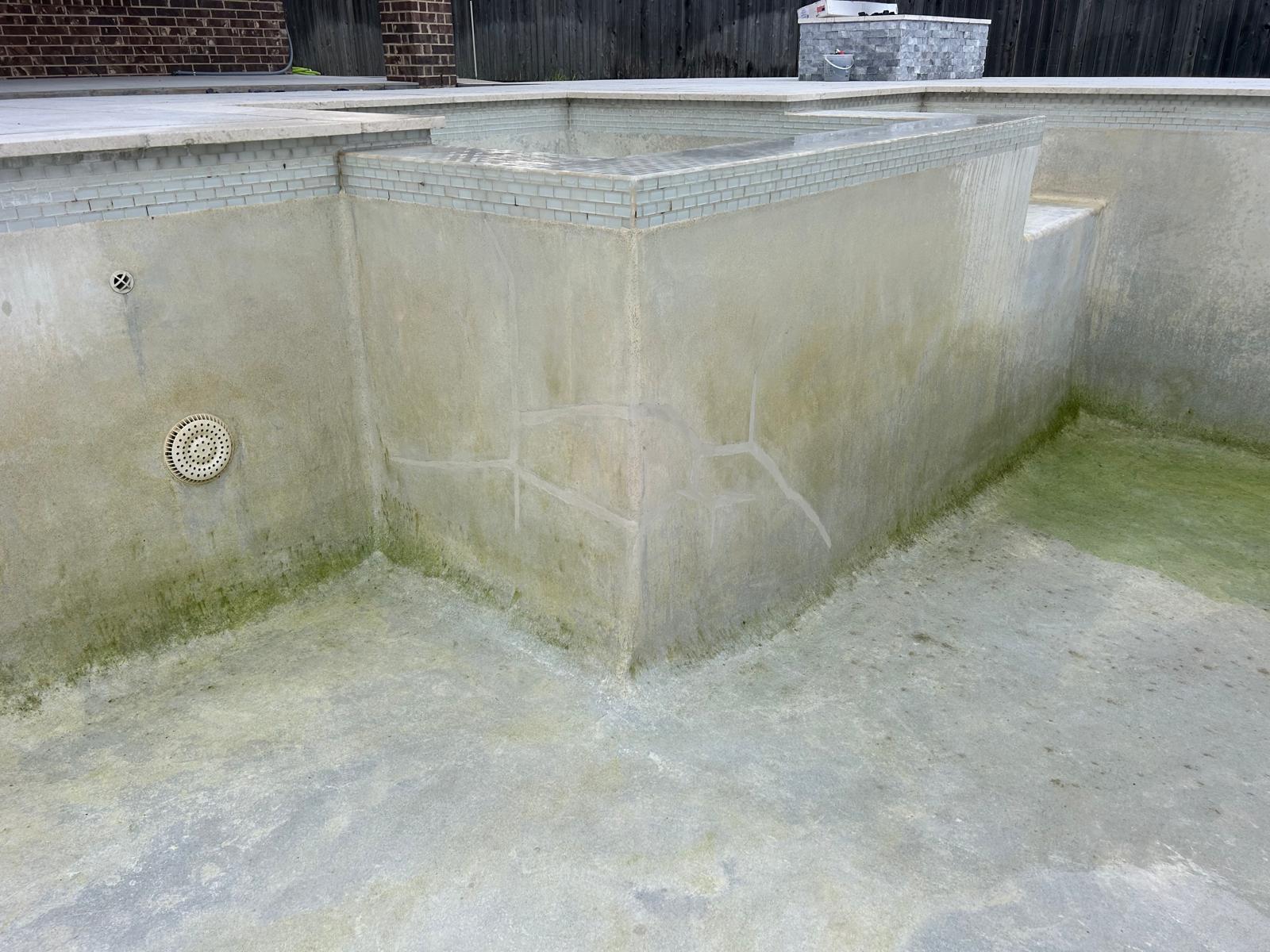
Filled, the crack lines are still visible against the old surface, as you can see above. That is expected. A structural repair is not a cosmetic one, and the finish comes afterwards — either a patch and blend, or new plaster if the pool was due for it anyway.
Honestly, if a pool needs its shell cracks repaired and its surface is already fifteen years old, doing both at once is the better value. The pool is drained once instead of twice.
What we do first, before anyone talks about draining
Before draining a pool for crack repair, we want to know two things. Is the crack actually where the water is going — because a visible crack and an active leak are not automatically the same thing. And are the lines sound, because there is no sense draining a pool for the shell while a return line is also leaking.
That means a dye test on the crack and a pressure test on every line first. It is a short visit and it occasionally saves the whole job.
We do structural crack repair around Montgomery, Conroe and the lake. Call (346) 850-9775.
Common Questions
Do you have to drain a pool to fix a crack?
For a structural crack through the shell, yes — the repair has to be made and cured dry. Many other leaks, including plumbing leaks and some joint and fitting leaks, are found and repaired with the pool full.
Is it dangerous to drain a swimming pool?
It carries real risk. With a high water table the empty shell can be pushed up out of the ground, and old plaster can craze as it dries in the sun. We check ground conditions and weather first and keep the pool empty for as little time as possible.
Why does the crack look bigger after you start?
Because it has been chased out on purpose. A hairline crack gives a repair nothing to bond to, so it is cut back into a clean groove with sound material on both sides. The opened groove is what makes the repair last.