
Pool Structural & Crack Repair in Houston, TX
Schedule Your Leak Detection Today
The leaks won’t fix themselves. Prevent high bills and long-term damage.
Plan long-term solutions with an in-depth assessment.
Cracks Look Alarming — but Most Aren't Leaking
A new crack in a pool is unsettling, and the first fear is always the same: is the whole pool failing? Here’s the reassuring part — most cracks an owner notices are cosmetic and never lose a drop of water. The work that matters is telling those apart from the few cracks that are genuinely structural and leaking, because the repair, the cost, and the urgency are completely different.
At Orbit Pool Leak Detection, that’s exactly what we do across Greater Houston: confirm whether a crack is actually leaking, then repair the ones that are — properly, not cosmetically — backed by a 60-day detection accuracy guarantee and a 2-year repair warranty.
Not Every Crack Is a Leak
Plaster and gunite naturally develop fine surface lines as they cure and age — hairline “check cracks” and crazing that you can see but that never reach through the shell. These are cosmetic and stable. A structural crack is different: it runs through the shell, often widens toward its ends, and opens a path for water to escape into the soil behind the pool. The catch is that the two can look almost identical from the deck — which is why guessing, or panicking, helps no one.
When a Crack Actually Threatens the Pool
The cracks worth taking seriously tend to appear where the shell carries the most stress: the corners, the deep end, around steps and benches, at the spa tie-in, and along tile and expansion joints. In Houston, the usual trigger is the ground itself — expansive clay swells and shrinks with the seasons, slowly flexing the shell until a stress point gives. A leaking structural crack won’t heal on its own; left alone, it keeps washing soil out from behind the shell, and the problem only compounds.
First, We Confirm the Crack Is the Leak
A visible crack and an actual leak aren’t always the same thing — your water could be escaping somewhere else entirely. So before any repair, we prove it:
- Dye testing directly at the crack in still water to watch whether it truly draws
- Pressure testing the plumbing to rule out a line leak that just happens to sit nearby
Only a crack that genuinely takes on dye gets treated as structural — the same evidence-first standard behind all of our pool leak detection.
Repairing It So It Holds — Not Just Hiding It
A confirmed structural crack needs more than a skim of plaster over the top. We open the crack along its length, clean it back to sound material, and bond it with a structural-grade repair that seals the leak and lets the shell flex without re-cracking — then finish the surface so it blends back in. The same approach handles cracked steps, benches, and spa tie-ins, where movement concentrates.
Every repair ends with a dye re-test, so you can see the crack no longer takes water — not just that it looks better.
The Other Structural Leaks We Seal
A cracked shell isn’t the only way a pool loses water through its structure. Two of the most common — and most overlooked — are the tile line and the light niche. Over the years, grout along the waterline tile breaks down and lets water work in behind it, and the conduit running to a pool light can crack or pull loose at the niche, opening a quiet path for water to escape. We seal both as part of our structural work:
- Tile regrouting along the waterline to close the gaps water slips through
- Light conduit repair where the line or niche has cracked or separated
Each is a small repair that stops a leak most owners never think to check — and both are confirmed with dye testing, the same way we verify every crack.
Recent Jobs Like This
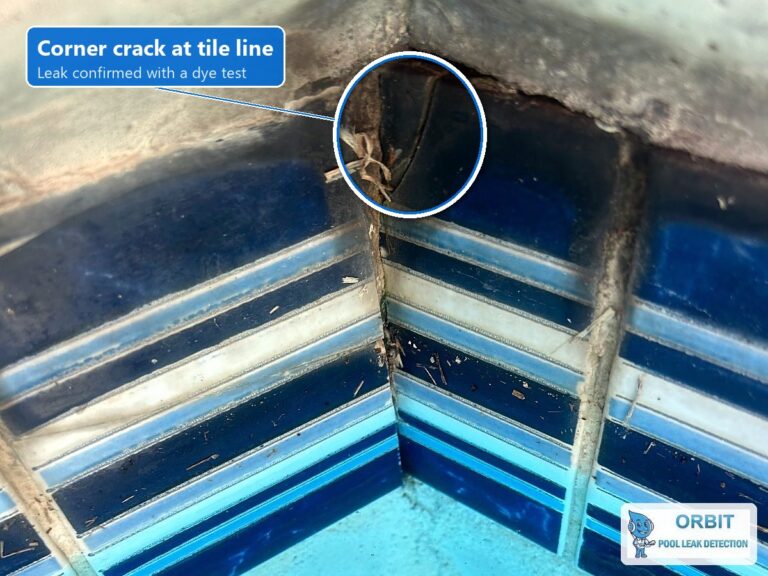
Corner Cracks Confirmed With Dye, Houston
Dye released at the cracked corners, right where tile meets plaster, flowed into the openings. Those corners were leaking, while roughly 25 feet of hairline cracks on the floor looked cosmetic.
Read the full case →