Sheer Descents and Grotto Walls: The Water Feature Leaks You Cannot See
Every other pipe in a pool is buried in dirt. Water feature plumbing is not. It runs up inside a wall — through the stacked stone of a grotto, behind the facing of a raised planter, through the block core of a sheer descent wall. That one structural difference changes how these leaks behave, how long they hide, and what they damage on the way.
Schedule Your Leak Detection Today
The leaks won’t fix themselves. Prevent high bills and long-term damage.
Plan long-term solutions with an in-depth assessment.
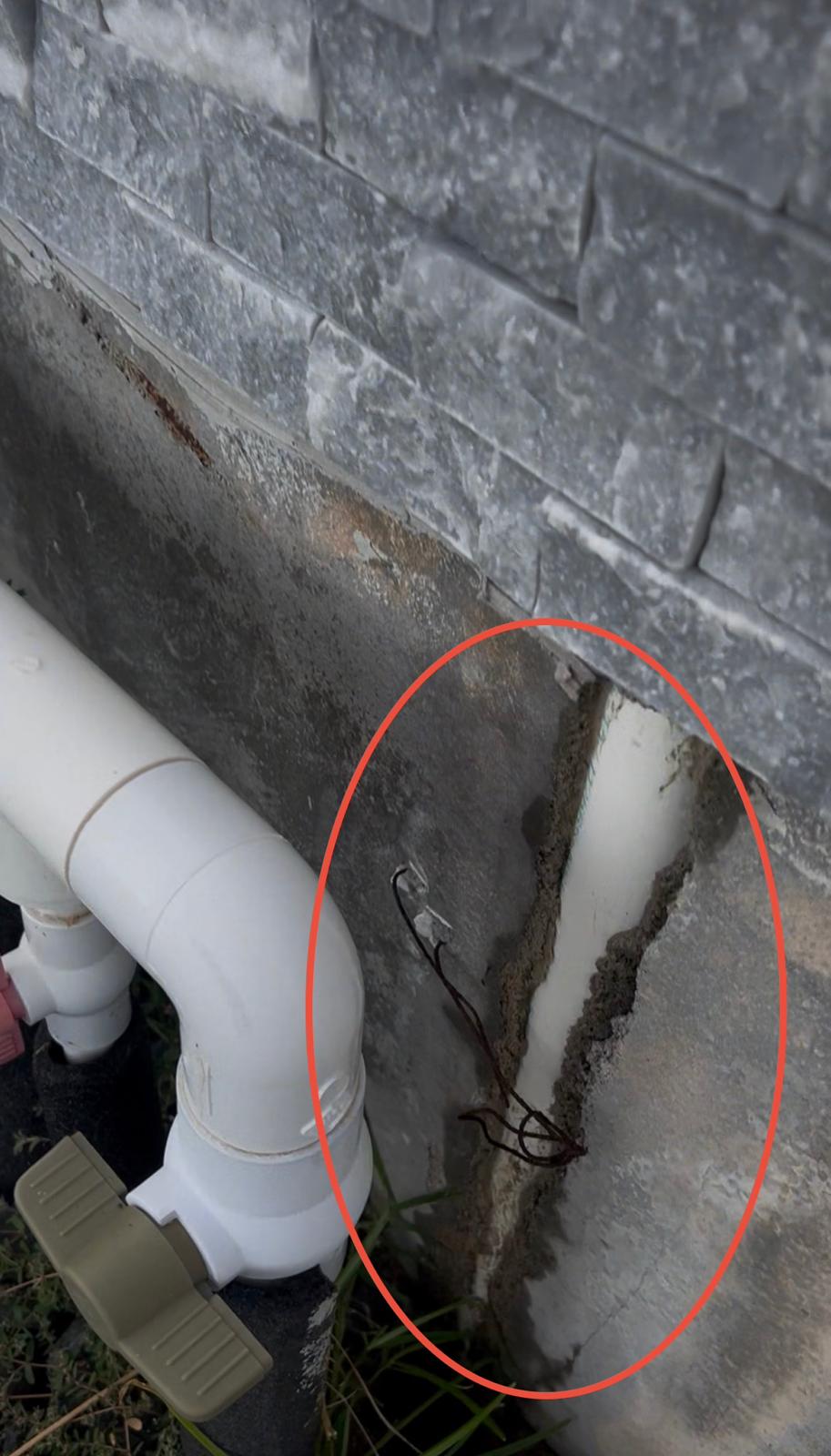
A sheer descent, that flat sheet of water pouring into the pool, is fed by a pipe that has to reach the top of the wall. The pipe goes up inside the wall cavity, is embedded in the core, and terminates at the feature. The photo above is one of those lines exposed for repair. You can see the PVC running vertically inside the wall behind the stone facing, with rust staining and white mineral deposits around the opening — the same efflorescence signature that means water has been passing through this material for a long time. There is also rusted wire tie visible, which is what happens when embedded metal spends years in contact with moving water. The feature supply line exposed inside the wall, with staining around the opening.
Why they hide for so long
A buried pipe that leaks makes wet ground. Someone eventually notices a soggy patch. A pipe leaking inside a wall does none of that. The water goes into the wall cavity, runs down through the core, and exits at the base — often under the deck, into a planting bed, or into the pool itself where it is invisible. The obvious clue never appears. Three more things extend the hiding period: Features are used intermittently. Most people run the waterfall when they are entertaining, not daily. A leak that only happens when the feature valve is open leaks a few hours a week, which is slow enough to blame on evaporation for a year or more. The loss looks like normal pool loss. Because the feature draws from the same body of water, the level drop shows up on the pool. Nothing points at the wall. Stone hides everything. By the time staining or a loose stone appears on the facing, the water has usually been working on the wall core for a long while.
The Conroe and Lake Conroe factor
Around Conroe and Montgomery there are a lot of custom pools — grottos, rock waterfalls, multi-level features, spillways designed to fit sloping lakefront lots. Those are exactly the builds with the most feature plumbing hidden inside structure. Lakeside and sloped lots add two pressures. Ground behind a raised feature wall drains toward the slope, so the wall’s back side stays wetter than the front. And any settlement in that slope pulls on a wall that has rigid pipe cast into it, which is a good recipe for cracked fittings at the joints. Seasonal use makes it worse. A feature that sits dry for months and then runs hard for a weekend goes through a thermal and pressure swing that constant-use plumbing never sees.
The test any owner can run
This one is simple and it isolates the feature cleanly:
Week one: run the pool normally with the feature off, and track the daily drop
Week two: run the feature on its usual schedule, and track again
Keep the autofill off during both weeks or the results are meaningless
If week two loses clearly more, the feature side is involved. If both weeks are the same, the feature is not your problem and the search moves elsewhere.
What we do differently on feature leaks
Because the pipe is inside structure, guessing is expensive. We pressure test the feature line separately from the rest of the plumbing, then locate the failure point acoustically before opening anything. The goal is always to open the smallest possible section of facing. Stone facing can usually be removed and reset if it is taken apart deliberately; it cannot be if a wall is demolished to find a pipe. That is the entire reason for locating first and cutting second. We handle water feature leak detection and repair and pool leak detection across Conroe and Montgomery. If your pool only loses water when the waterfall runs, call (346) 850-9775.
Common Questions
How do I know if my waterfall is leaking?
Run the pool for a week with the feature switched off and track the water level, then run it a week with the feature on. If the loss is clearly worse in the second week, the feature plumbing or the feature basin is where the water is going.
Why are water feature leaks harder to find?
Because the supply lines usually run inside the feature wall rather than in the ground. Water escaping inside a stacked stone wall travels down through the wall cavity and can surface far from the actual break, or never surface at all.
Can a sheer descent be repaired, or does the whole wall come apart?
Most repairs are localized. We pinpoint the failure first so only the affected section of facing is opened. Full disassembly is a last resort, not the starting point.
Hi! I'm Orbit's assistant. Ask me anything about pool leak detection and repair — how our service works, pricing, scheduling, or your specific pool problem.
AI answers may be imperfect. For urgent issues, please contact us directly.