Your Autofill May Be Hiding a Leak — and Paying for It Every Month
An autofill does exactly one job: keep the water level constant no matter what. It is genuinely useful equipment through a Gulf Coast summer, when evaporation alone can pull down a quarter inch a day. But think about what “keep the level constant no matter what” means when something goes wrong. The autofill cannot tell the difference between water that evaporated and water that escaped through a cracked return line. It replaces both, silently, around the clock. The first symptom of a leak — a dropping water level — is the exact symptom the autofill exists to erase.
Schedule Your Leak Detection Today
The leaks won’t fix themselves. Prevent high bills and long-term damage.
Plan long-term solutions with an in-depth assessment.
The water still has to come from somewhere, so the leak does not disappear. It just changes address, from the pool to the utility bill. That is a much worse place for it, because water bills fluctuate for ordinary reasons — a hot month, guests, more irrigation — so a gradual climb is easy to rationalize. Meanwhile the leak keeps running underground, washing soil out from under the deck the whole time. We regularly find leaks that had been running for a year or more on pools where the level never once looked wrong. The homeowner did nothing careless. Their equipment was working perfectly, doing what it was designed to do.
The 48-hour test
This is the single most useful thing an autofill owner can do, and it costs nothing:
Find the autofill’s shutoff valve — usually at the equipment pad or in the autofill box itself
Close it completely
Mark the water level precisely with tape on the tile
Wait 24 to 48 hours, running the pump on its normal schedule
Measure the drop, then open the valve again
In summer here, a quarter inch a day is roughly what evaporation accounts for. Half an inch a day or more, consistently, is not evaporation. Anything past an inch a day deserves attention this week rather than next season. Do not skip turning it back on. A pool that drops below the skimmer will pull air, and a pump that runs dry is a much more expensive problem than the one you were investigating.
When the autofill is the leak
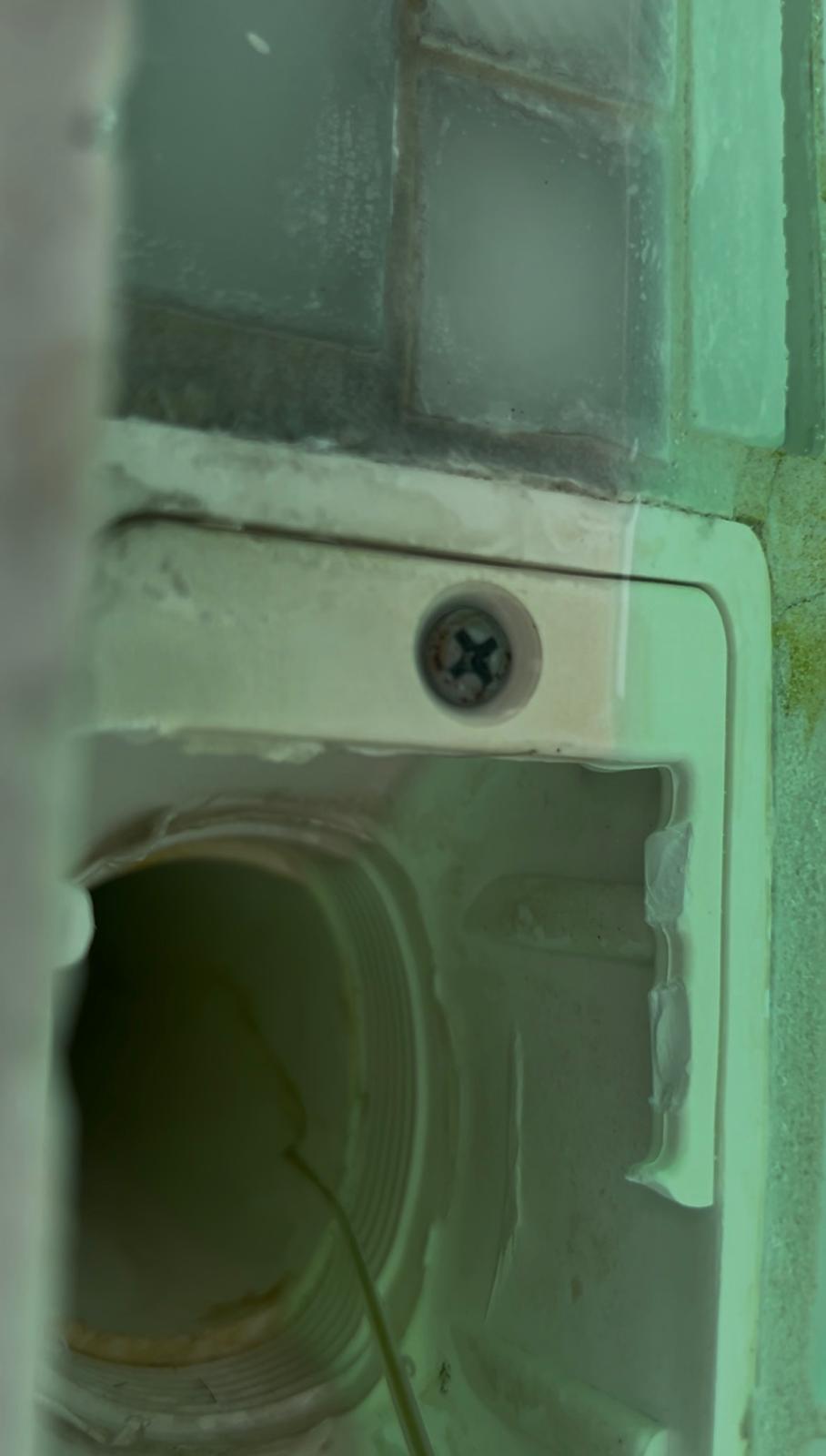
There is a second failure mode, and it is the one in the photo above. Inside the autofill housing is a valve, usually float operated, that opens when the level drops and closes when it recovers. It is a mechanical part sitting permanently in water. The image shows the inside of one of these housings with heavy mineral scale built up around the fill line. Scale is what our water leaves behind, and once it accumulates on the valve seat or the float arm, the valve stops closing fully. It does not fail dramatically. It just never quite shuts. Now water runs continuously. Because most installations are plumbed with an overflow to the drain line, the excess leaves quietly instead of flooding the deck. The pool looks fine. The pool is fine. The meter spins anyway. Mineral scale inside the autofill housing keeps the valve from seating.
Telling the two apart
Both problems raise the bill, but they separate quickly:
Shut the autofill off. Pool level holds steady? The autofill was the problem. Level drops? You have a real leak.
Listen at the autofill box with the pool at normal level and everything off. A faint continuous hiss means the valve is passing water.
Check the meter with all water in the house off and the autofill closed. Movement means something else on the property is running.
That third check matters more than people expect, because irrigation leaks are frequently blamed on pools. Isolating the autofill takes the pool out of the equation entirely.
Why League City and Dickinson see both versions
This part of Galveston County has hard water and long cooling seasons, which is a combination that builds scale. Autofill valves here accumulate deposits faster than they would in softer water, so the stuck-open failure is common. The area also has a high water table and soil that stays damp much of the year. That matters because a leak into already-saturated ground produces no dry-spot clue, no sinkhole, no obviously soggy patch that stands out from the rest of the yard. Combine damp ground that hides the symptom with an autofill that hides the level, and a leak can run a very long time with nothing to give it away but a bill. We do pool leak detection and equipment repair throughout League City and Dickinson. If your bill has been climbing and your pool looks perfect, that combination is worth a call: (346) 850-9775. More answers on our pool leak FAQ.
Common Questions
Can a pool leak while the water level looks normal?
Yes, and it is common on pools with an autofill. The device replaces lost water automatically, so the level stays perfect while the leak continues. The evidence moves from the pool to the water bill.
How do I test my pool for a leak if I have an autofill?
Shut the autofill off at its valve, mark the water level, and watch it for 24 to 48 hours. Without the autofill topping it up, any real loss becomes visible. Remember to turn it back on afterward.
Can the autofill itself be the leak?
It can. If mineral scale keeps the valve from seating fully, it runs continuously and the overflow goes to the drain line. Your bill climbs even though the pool is fine and never overflows.
Hi! I'm Orbit's assistant. Ask me anything about pool leak detection and repair — how our service works, pricing, scheduling, or your specific pool problem.
AI answers may be imperfect. For urgent issues, please contact us directly.