
Will We Have to Break Up Your Deck to Fix the Leak?
This is the question we get asked before almost anything else, and usually before the customer asks what it costs. It is a fair worry. Most people picture a jackhammer, a pile of broken concrete, and a patch that never matches.
The honest answer is that the deck sometimes has to be opened. What we can promise is how much of it — and on a properly located leak, the answer is normally a hole you could cover with a dinner plate.
Why the pipes end up under the concrete in the first place
When a Richmond pool is built, the plumbing is trenched in first and the deck is poured over it afterwards. The lines fan out from the equipment pad and run around the shell, and the shortest path is almost always straight under where the deck will be.
That is not bad workmanship. It is simply how a pool is built. It does mean that when a joint fails twenty years later, the failure is under four inches of concrete rather than out in the lawn.
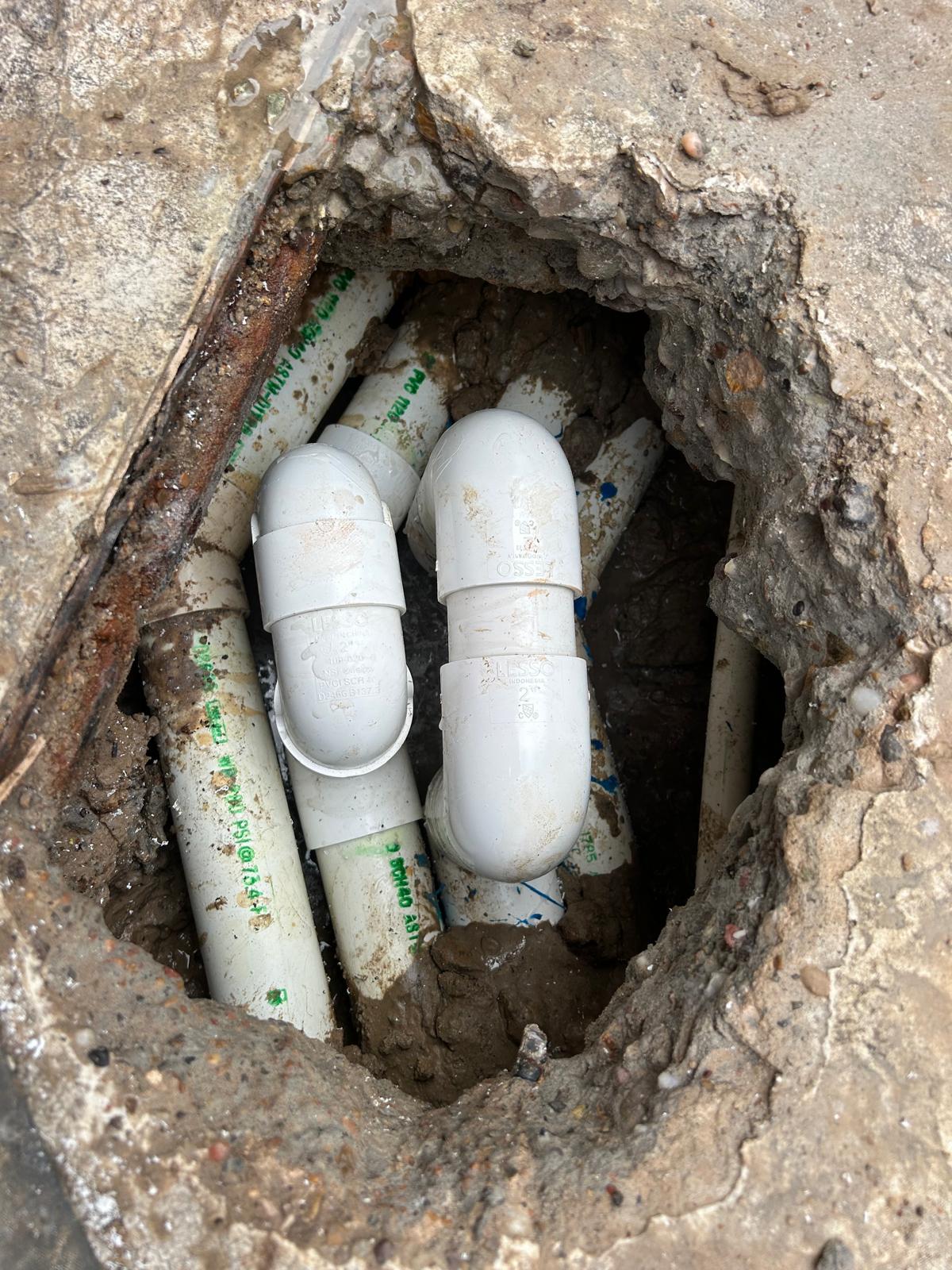
Look at the photo above and you can see the second reason we do not guess. That is not one pipe down there. It is five or six of them lying side by side, a few inches apart, all heading in the same direction. Open the wrong spot and you have broken your deck for nothing, and you still have to open it again somewhere else.
What decides the size of the hole
The size of the opening is set entirely by how well we located the leak beforehand, not by how careful we are with the saw.
- Located to within a foot — a hole around eighteen inches across, enough to get two hands and a saw in
- Located to a general area — a longer trench, opened progressively until the wet spot appears
- Not located at all — exploratory digging, which is where the horror stories come from
That is why we do not skip pressure testing. Isolating each line and listening along its run is what turns a whole patio into one opening.
Cutting, repairing and closing back up
Once the spot is marked, the concrete is cut rather than broken. A cut edge gives a clean square shoulder for the patch to key into, and it stops cracks running out into the rest of the slab the way a hammer does.
Under the slab the bad section is cut out and new pipe is glued in. In the photo those are two new two inch elbows carrying the line around the failure. The repair is pressure tested again before anything is buried, because nobody wants to close a deck twice.
Then the hole is backfilled and compacted in layers. Loose fill is what makes a patch sink and crack a year later, and Richmond’s clay does not forgive a rushed backfill.
About the patch matching
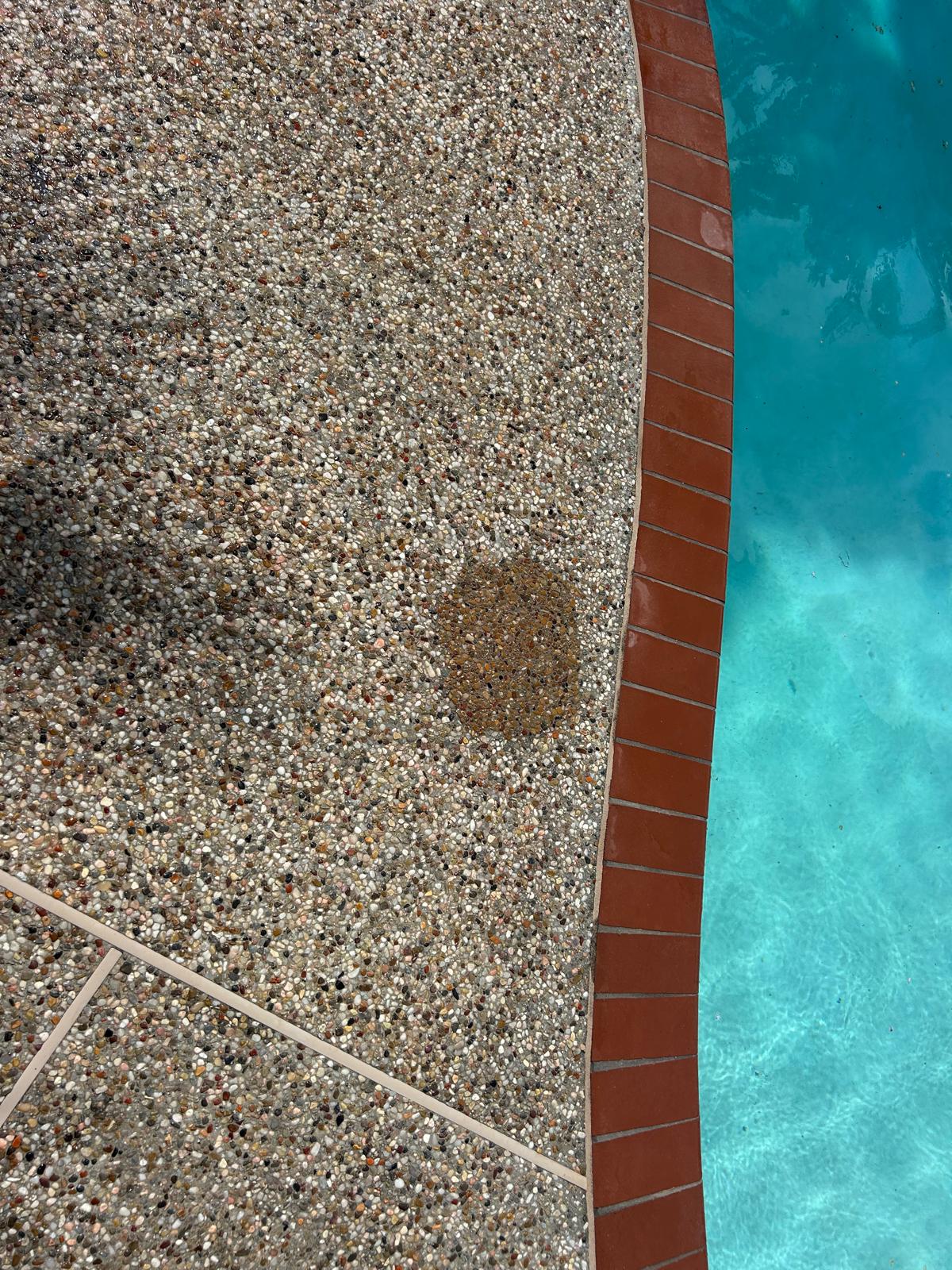
We will not tell you a patch disappears. On an exposed aggregate deck like the one above we match the stone as closely as we can source it, and the new concrete cures lighter than the old for the first few months before it weathers in.
On a plain broom finish deck a patch is easier to hide. On stamped or stained concrete it is harder, and we will say so before we start rather than after. If the finish is one that will never match well, that is worth knowing while you still have the choice of repair method.
When opening the deck is the wrong answer
Sometimes it is. If a line has failed in three places already, or the pipe is thin wall and brittle throughout, cutting a fourth hole is throwing money at a pipe that is going to fail again. In that case rerouting the line on a new path — often around the deck rather than under it — costs less over five years than a series of patches.
We would rather tell you that on the first visit than on the third.
What to do before we arrive
Two things help more than anything else. Mark the water level with a piece of tape and note how much you lose in twenty four hours. And walk the deck barefoot in the early morning: a warm damp patch, a section that has settled, or a joint that stays wet long after the rest has dried are all worth pointing out.
We cover Richmond and the rest of Fort Bend County for return line repair and full leak detection. Call (346) 850-9775 or book online.
Common Questions
How big a hole do you cut in a pool deck?
On a leak that has been properly located, usually around eighteen inches across — enough to work two hands and a saw around the pipe. The size depends on how precisely the leak was pinpointed before the saw came out, not on the repair itself.
Will the concrete patch match my existing deck?
It will be close but not invisible. Exposed aggregate and plain finishes match well once the new concrete has weathered a few months. Stamped and stained decks are harder, and we will tell you that before we cut rather than afterwards.
Why not just dig around the deck instead of through it?
Sometimes we do, when the leak is near the edge. But pool lines usually run under the slab, and reaching a leak in the middle of the run from the side means tunnelling blind under concrete you cannot see or support.