Weak Spa Jets in Cypress? The Air Line Is Often the Culprit
A spa jet is not just water shooting out of a hole. It is water and air mixed together, and the air is what makes it feel like a spa instead of a garden hose. So when the jets go soft, there are two systems that could be at fault. Almost everyone checks the wrong one first.
Schedule Your Leak Detection Today
The leaks won’t fix themselves. Prevent high bills and long-term damage.
Plan long-term solutions with an in-depth assessment.
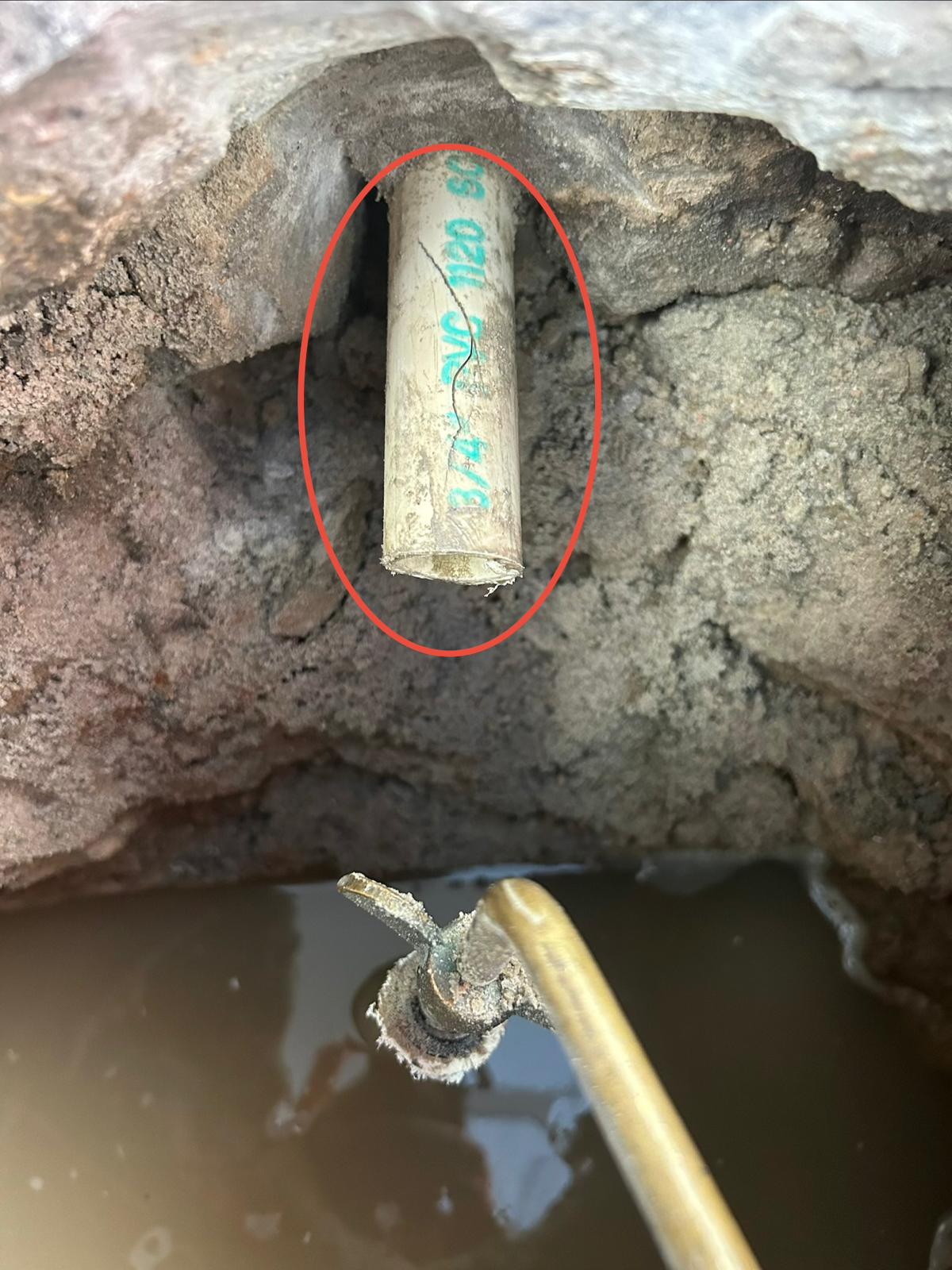
Each jet has two feeds. Water arrives under pressure from the pump. Air arrives through a separate, much smaller line — usually three quarter inch PVC — fed either by a blower or by a venturi that pulls air in as water rushes past it. Those two streams meet inside the jet body. The air becomes bubbles, the bubbles expand the volume of the stream, and that is the sensation you feel. If the water feed fails, the jet stops or dribbles and it is obvious. If the air feed fails, water still comes out at what looks like normal flow — it just feels flat and lifeless. That is why people replace pumps that were never the problem. The split runs lengthwise down the 3/4 inch air line, circled where we found it.
Why air lines crack before water lines
The pipe in the photo is a three quarter inch spa air line with a split running down its length, circled where we found it in the excavation. That failure mode is common, and there are reasons for it. Thinner wall. Air lines are small diameter and often thinner walled than pressure plumbing, because they were never meant to carry pressurized water. Shallower burial. They tend to run closer to the surface than main plumbing, which puts them nearer to deck loads, tree roots, and the zone of soil that dries out and shrinks the most. Thermal cycling. Air lines connected to a blower carry warm air. Heated, cooled, heated again, every use. They split lengthwise. Notice the crack in the photo runs along the pipe rather than around it. That is what happens when a pipe is squeezed or stressed from the side rather than pulled apart — and a long split leaks along its whole length rather than at one point.
The Cypress and Spring pattern
Northwest Harris County built out fast, and a lot of the spas here went in during the same wave of construction. That means a large number of them are hitting the same age at the same time, with the same materials and the same installation practices. The soil through Cypress and Spring is a mix — clay in most places, sandier pockets in others — and mixed soil is not kinder than uniform soil. It settles unevenly. A shallow air line crossing from one soil type to another gets bent slightly, over and over, until it splits. There is also a lot of mature landscaping in these neighborhoods now that was not there when the spas were built. Roots go where the water is, and a shallow line with a weeping crack is a beacon.
Finding it without tearing up the deck
Air lines are actually easier to test than water lines, because you can pressurize them with air and listen. We isolate the line at the equipment pad, pressurize it, and watch whether it holds. A line that bleeds down has an opening. From there we listen along the run with electronic equipment, and the escaping air gives a distinct signature at the failure point. Because these lines run shallow, the excavation is usually modest — a small opening rather than a trench. In the photo you can see the pipe stub exposed in exactly that kind of targeted dig, with the pressure test rig still connected below it.
What else to rule out first
Before assuming the line, a few things are worth checking, because they cost nothing:
Air control valves on the deck — they may simply be closed or seized
The blower, if the spa has one, and whether it is running at all
The water level — a spa filled too high can drown the venturi air intake
Filter condition, since restricted flow weakens the venturi effect that pulls air in
Whether all jets are weak or only some, since a single weak jet is usually a blockage rather than a line failure
If those check out and the jets are still flat across the whole spa, the line underground is where to look. We do spa jet repair and spa leak detection throughout Cypress and Spring. If your jets went soft and the pump sounds fine, call (346) 850-9775 before you replace equipment that is working.
Common Questions
Why did my spa jets get weak all of a sudden?
If the water flow still looks normal but the jets lost their fizz, the air side is the likely problem. Spa jets mix air into the water stream, and a cracked or blocked air line starves that mix even when the pump is working perfectly.
Does a cracked air line leak water?
It can, in both directions. Below the water line an air line can let water escape into the soil, and it can also let groundwater and silt into the system. Either way the jet action suffers.
Can a cracked air line be repaired without redoing the spa?
Usually yes. Air lines run shallow, and once the crack is pinpointed the repair is normally a small excavation and a new section of pipe rather than a full replumb.
Hi! I'm Orbit's assistant. Ask me anything about pool leak detection and repair — how our service works, pricing, scheduling, or your specific pool problem.
AI answers may be imperfect. For urgent issues, please contact us directly.