Vertical Cracks in Pool and Spa Corners: What Katy Homeowners Should Know
Surface cracking in plaster is common and usually harmless — thin, random, spidery lines that come from the finish curing. A crack that runs straight down a corner is a different animal. It has direction, and direction means force.
Schedule Your Leak Detection Today
The leaks won’t fix themselves. Prevent high bills and long-term damage.
Plan long-term solutions with an in-depth assessment.
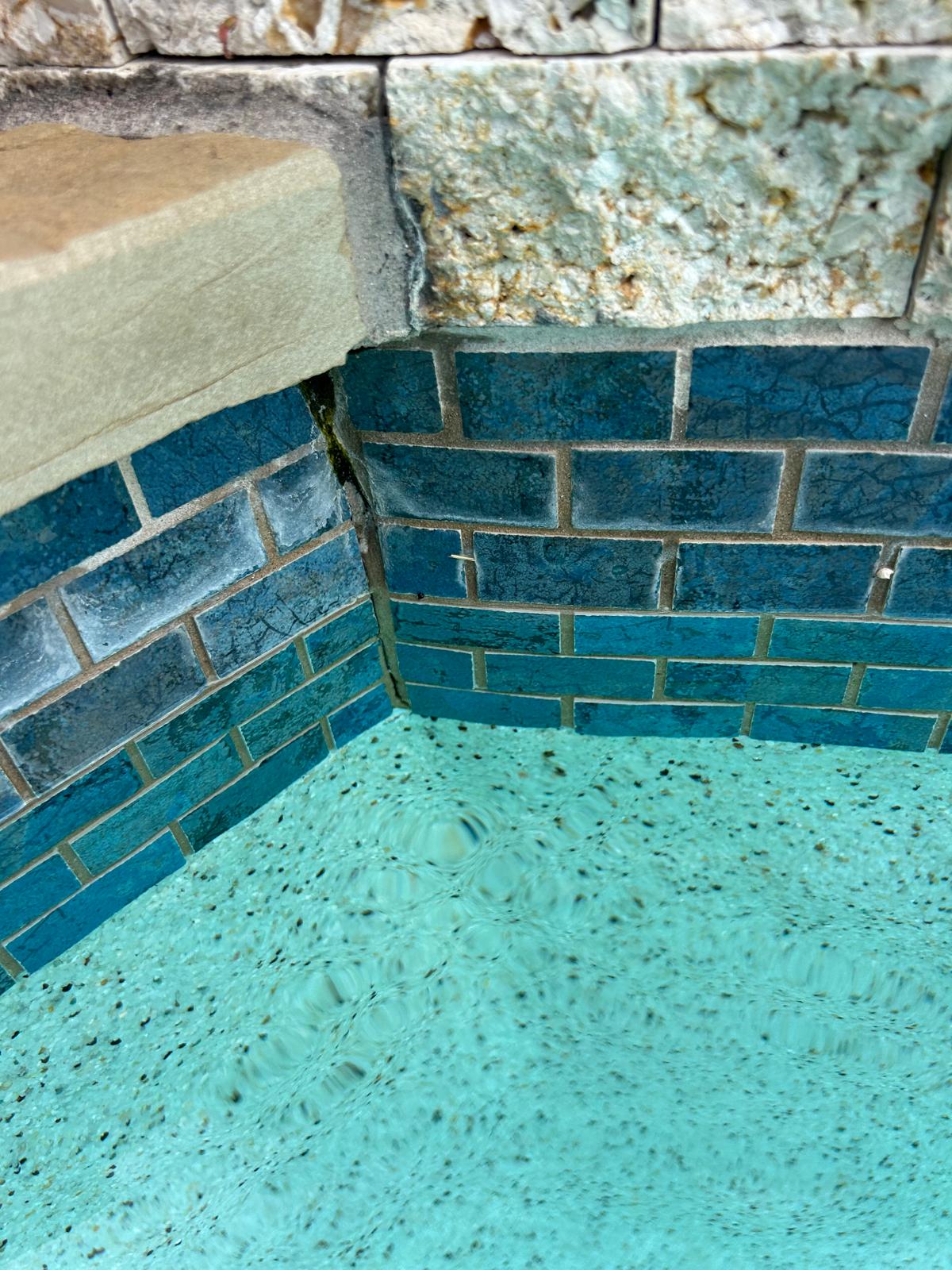
Think about where the shell changes shape. A wall meeting another wall, a spa meeting a raised bond beam, a step meeting the floor. At those junctions the concrete cannot flex evenly in every direction, so any load that would spread harmlessly across a flat wall gets funneled into the corner instead. It is the same principle that makes drywall cracks in a settling house start at the top corner of a doorway. The corner is not weaker material — it is where the math concentrates. So when the ground under one end of a pool moves and the other end does not, the corner is where the shell gives. A vertical corner crack that runs through coping, tile and shell on one line.
Reading the crack in the photo
The image above is a spa corner where the crack runs from the coping down through the tile and continues below the waterline. Two details matter more than the crack itself. First, it is continuous. It does not stop at the tile line or wander. A crack that crosses materials — coping, tile, grout, shell — on the same line is following a movement in the structure underneath, not a defect in any one layer. Second, there is growth inside it. Algae and dark buildup in the crack line only happen when water has been sitting and moving in that gap for a long time. Fresh structural cracks are clean. This one has been open for seasons. That combination tells us it is worth pressure testing the spa and checking whether the crack has become a leak path, rather than filling it and hoping.
The Katy and Fulshear pattern
West of Houston, a lot of neighborhoods went up quickly on former prairie and farmland. The ground was cut, filled, and compacted, then houses and pools followed within a couple of years. Fill soil keeps settling after construction ends. It is not dramatic — fractions of an inch — but it is uneven, and a pool shell is a rigid box sitting across it. When one corner of that box is supported slightly differently than the others, the shell has to absorb the difference. That is why we see corner cracks in Katy pools that are only three to six years old, which surprises homeowners who assume cracking is an old-pool problem. It is not about age. It is about whether the ground finished moving before the concrete was poured. Layer on the region’s flat, poorly draining prairie clay, which holds water after storms and then shrinks hard in August, and you get a yearly push-pull that keeps working on the same corner.
Does a corner crack mean the pool is leaking?
Not automatically. Plenty of corner cracks are structural signals that have not yet become water paths. What decides it is whether the crack goes through the shell or only through the finish. Signs it has become a leak:
Water level drops steadily whether the pump runs or not
The level settles at a specific height and then holds
Damp, spongy, or sunken ground outside that corner
Staining or mineral deposits tracking down the outside of the wall
The crack has visibly widened between seasons
A dye test at the crack, done with the pump off and the water still, answers it quickly. If dye pulls into the crack, water is going out through it.
Why patching alone often fails
Filling a moving crack with a rigid patch produces a repair that cracks again in the same line, usually within a year. The patch is not the weak part — the movement is still happening. A repair that holds means cutting the crack out into a channel so there is real material to bond to, treating it as a structural joint rather than a surface blemish, and where the movement is ongoing, addressing the drainage or soil condition that is driving it. Sometimes that is as simple as redirecting a downspout that has been soaking one corner of the yard for years. We handle structural and crack repair and spa leak detection across Katy and Fulshear. If a crack in your pool or spa has a direction to it, call (346) 850-9775 and we will tell you whether it is moving water or just moving.
Common Questions
Is a vertical crack in a pool corner serious?
More serious than a surface craze line, yes. Vertical cracks at corners usually mean the shell is being pulled by ground movement rather than just shrinking. They also tend to run through the full thickness rather than staying in the plaster.
Why do cracks show up at corners specifically?
Corners are where two planes of the shell meet, so stress from any movement concentrates there instead of spreading out. It is the same reason cracks in a house start at window and door corners.
My pool is only four years old. Should it be cracking already?
It should not, but on newer Katy builds it does happen. Pools built on prairie fill settle for several years after construction, and a shell that was poured before the ground finished moving can crack in year two through five.
Hi! I'm Orbit's assistant. Ask me anything about pool leak detection and repair — how our service works, pricing, scheduling, or your specific pool problem.
AI answers may be imperfect. For urgent issues, please contact us directly.