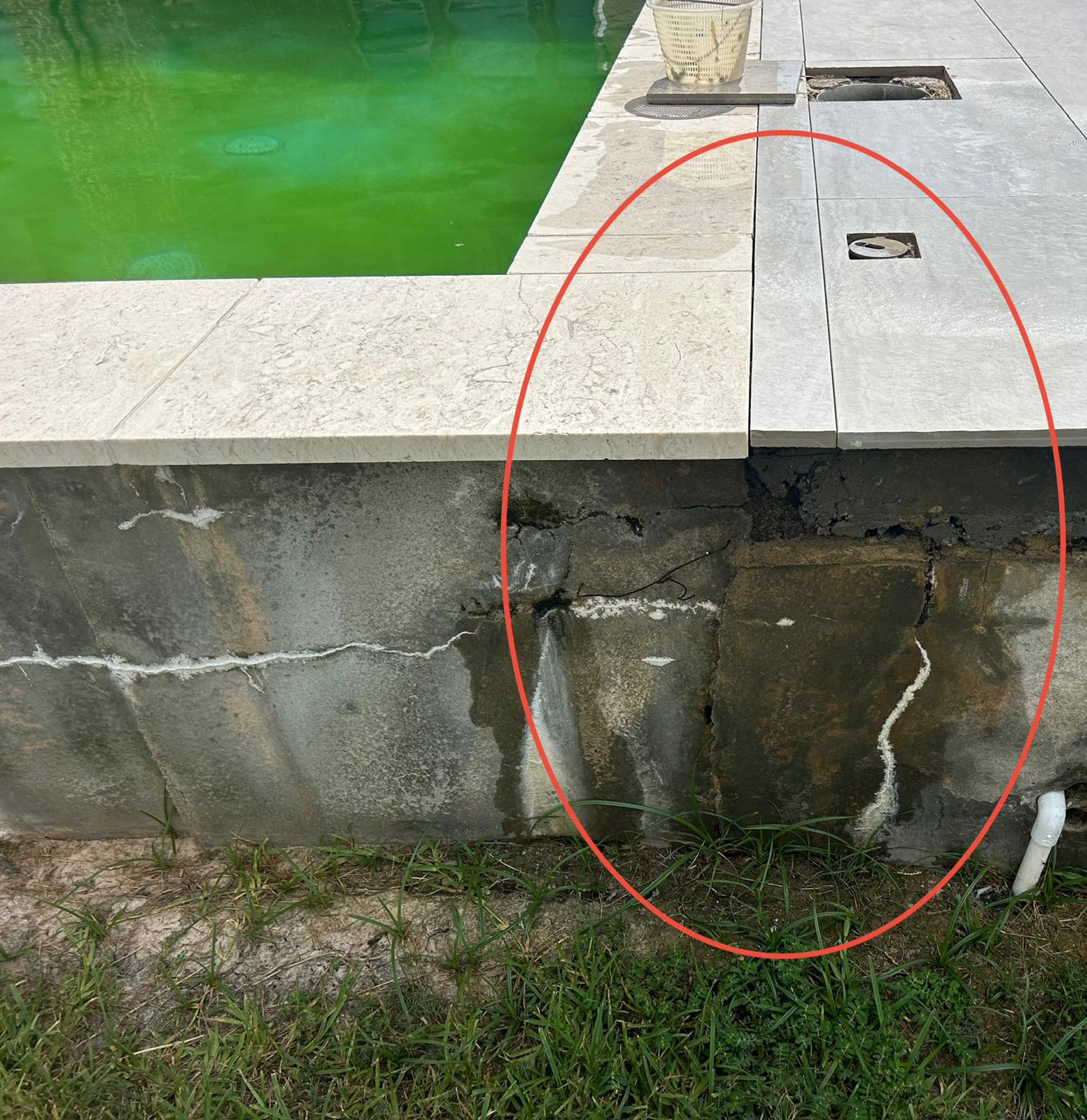
White Chalky Trails on Your Pool Wall: What They Mean in The Woodlands
If your pool has a raised or exposed wall — and a lot of pools in The Woodlands do, cut into sloping wooded lots — you can sometimes read its condition from the outside without any equipment at all. The thing to look for is white. Not a general haze, but distinct chalky trails running down the concrete, following the same path every time.
Schedule Your Leak Detection Today
The leaks won’t fix themselves. Prevent high bills and long-term damage.
Plan long-term solutions with an in-depth assessment.
Concrete is not waterproof. It is porous, and water under pressure will find its way through it. When pool water moves through the shell and reaches the outside face, it evaporates into open air. The water leaves. The dissolved minerals it was carrying — mostly calcium — cannot evaporate, so they crystallize on the surface. Repeat that for months and the deposit builds into a visible trail. This matters because it is evidence, not staining. Ordinary discoloration comes from something landing on the wall. Efflorescence comes from something passing through it. Every chalky trail marks a route water has been taking. Calcium trails on the outside face trace the route water has been taking.
How to read the pattern
The photo above is a raised pool wall where the deposits are doing several things worth noticing. There are horizontal white lines following what look like construction joints or form lines. Water is finding the seams and traveling along them before working outward. There are vertical trails below those lines, running straight down. That is gravity taking over once water reaches the open face. There is dark wet staining in the same zones, which means the wall is not just historically wet — it is currently wet. Dry efflorescence with no dark area suggests an old problem that has stopped. Wet efflorescence means it is active. And the deposits are concentrated in one region rather than spread evenly across the whole wall. Even distribution would suggest general porosity or groundwater. Concentration points to a specific path.
Why raised walls in The Woodlands show this
Two things make this common on wooded, sloped lots. The first is exposure. On a flat lot, the outside face of a pool wall is buried and you would never see the deposit. On a terraced lot where the pool sits above the grade below it, the outside face is open to the air — which is exactly the condition efflorescence needs to form visibly. The problem is not more common here, it is just more visible. The second is water behind the wall. Sloping lots shed rainwater downhill, and if the drainage behind a raised wall is undersized or has silted up over the years, that soil stays saturated. Saturated soil against a wall pushes water toward the drier side. That second point cuts both ways, which is why we test rather than assume. Sometimes those trails are pool water heading out. Sometimes they are groundwater or irrigation heading in through the same wall. The deposits look similar; the repair is completely different.
Sorting pool water from ground water
The distinction is usually settled by a few checks:
Does the pool lose water at a rate evaporation cannot explain?
Does the deposit get more active after rain, or after a stretch with no rain but heavy pool use?
Does the level drop faster with the pump running, pointing at plumbing rather than shell?
Does a dye test at suspect points on the inside show water pulling through?
Is there irrigation, a downspout, or a French drain outlet behind that section?
If the pool is holding its level and the trails still appear after rain, the water is coming from the hill, not the pool. That is a drainage repair, not a pool repair — and it is worth knowing before anyone starts cutting concrete.
Why it is worth acting on either way
Water moving through a wall does not stay neutral. It carries material out with it, gradually opening the path it travels. It reaches reinforcing steel and starts rust, and rusting steel expands, which cracks concrete from the inside. And on a raised wall, the soil behind it is being slowly washed out, which eventually shows up as a settling deck. None of that is an emergency this week. All of it is cheaper to address in the first year than the fifth. We do leak detection and structural repair throughout The Woodlands and Montgomery County. If your pool wall is growing white trails, call (346) 850-9775 and we will find out which side the water is coming from.
Common Questions
What are the white streaks on the outside of my pool wall?
They are efflorescence: mineral deposits left behind when water passes through concrete and evaporates on the far side. The water carries dissolved calcium out with it and the calcium stays on the surface as a chalky trail.
Can I just pressure wash the white deposits off?
You can remove them, and they will come back as long as water is still moving through the wall. The deposit is the symptom. Cleaning it only resets the clock and makes it harder to see how fast it is returning.
Do mineral trails always mean the pool is leaking?
Not always, but they always mean water is passing through the wall from somewhere. Sometimes the source is irrigation or poor drainage behind the wall rather than pool water. Finding out which is the first thing we test.
Hi! I'm Orbit's assistant. Ask me anything about pool leak detection and repair — how our service works, pricing, scheduling, or your specific pool problem.
AI answers may be imperfect. For urgent issues, please contact us directly.